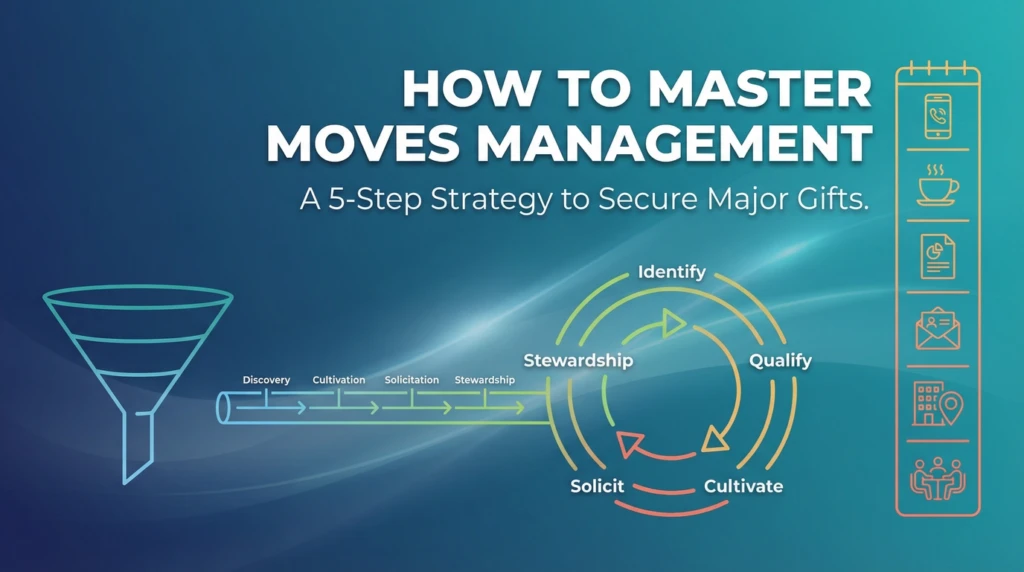
How to Master Moves Management: A 5-Step Strategy to Secure Major Gifts
Quick Summary:
Moves Management is a structured, relationship-driven fundraising strategy that guides donors through five intentional stages—Identify, Qualify, Cultivate, Solicit, and Steward—to consistently secure major gifts. Rather than relying on mass appeals or one-time transactions, it focuses on building long-term partnerships through personalized, meaningful interactions called “moves.”
This post breaks down each stage of the cycle, the psychology behind donor behavior, common pitfalls to avoid, and how small nonprofits can compete with larger organizations by staying focused and strategic. To run an effective Moves Management system at scale, you need the right tools to track every relationship, task, and touchpoint in one place. Donor Wrangler can help with that!
We know that running a nonprofit organization isn’t easy, as you constantly need to find new leads who are willing to donate to your cause. The biggest issue, though, is that you can’t just go to a potential prospect and tell them to make a donation to your non-profit, regardless of how noble your cause may be. We mean, you can, but the chances of that person opening their banking app and transferring a certain amount as a donation are quite slim, especially if this is the first time they’ve heard about your organization.
To maximize the probability of success, we advise you to use the so-called Moves Management system. Don’t worry if you’re hearing this name for the first time, or if you’ve previously heard it but didn’t know how to implement it. In this detailed guide on the Moves Management strategy, we explain what Moves Management is and how to scale a Moves Management system, which should be especially helpful if you’re a small to mid-sized nonprofit that wants to outperform larger organizations with bigger budgets. You’ll also learn the psychology behind donor behavior, the five essential stages of the moves management cycle, and how tools like Donor Wrangler can help you organize the entire process.
What Is Moves Management?
Moves management is a structured fundraising strategy that guides potential partners through a series of intentional interactions called “moves.” Picture it as a relationship roadmap, where the goal is building a bond and securing a major gift.
Key elements of moves management:
- It’s proactive and process-driven
- It focuses on long-term relationships, not one-time transactions
- It tracks donor readiness using capacity, inclination, and connection
- It ensures every donor moves forward through the giving pipeline
Just as in any relationship, you first find a partner and get to know each other; once you’ve built that trust, you then ask for their support. The concept was pioneered by David Dunlop at Cornell University, who recognized that big donations don’t happen by chance, but through intentional steps.
Why “Moves” Matter in Fundraising
A move is any intentional action that advances a donor from one stage of the giving cycle to the next.
A move is NOT:
- Sending a mass newsletter
- Posting a general update on social media
A move IS:
- A personalized phone call referencing a donor’s specific interest
- A handwritten note after a site visit
- A tailored invitation to a program they care about deeply
By using “moves,” you’re creating momentum and leading a potential benefactor toward a gift. Without them, prospects often stall, and as you’d likely agree, a stalled relationship rarely leads to a generous donation.
Moves Management vs. Traditional Fundraising
Most nonprofits still operate on a transactional model: “Who can give us money right now?” Moves management replaces this with a relational approach: “Who can we partner with for the next decade?”
| Feature | Traditional Fundraising | Moves Management |
| Philosophy | “We need money now.” | “We build long-term relationships.” |
| Communication | Mass emails, generic appeals | Personalized, 1:1 outreach |
| Data Usage | Names + addresses | Wealth, warmth, and connection |
| Success Metric | Dollars raised this month | Meaningful donor interactions |
| Donor Experience | Feels like an ATM | Feels like a valued stakeholder |
This shift in mindset is the foundation of sustainable major-gift fundraising.
The 5 Stages of the Moves Management Process
Because it’s a strategy that so closely mirrors a real-world relationship, the Moves Management system follows five distinct stages that every nonprofit should implement to successfully secure a major gift:
1. Identify — Build Your Circle of Mission Champions
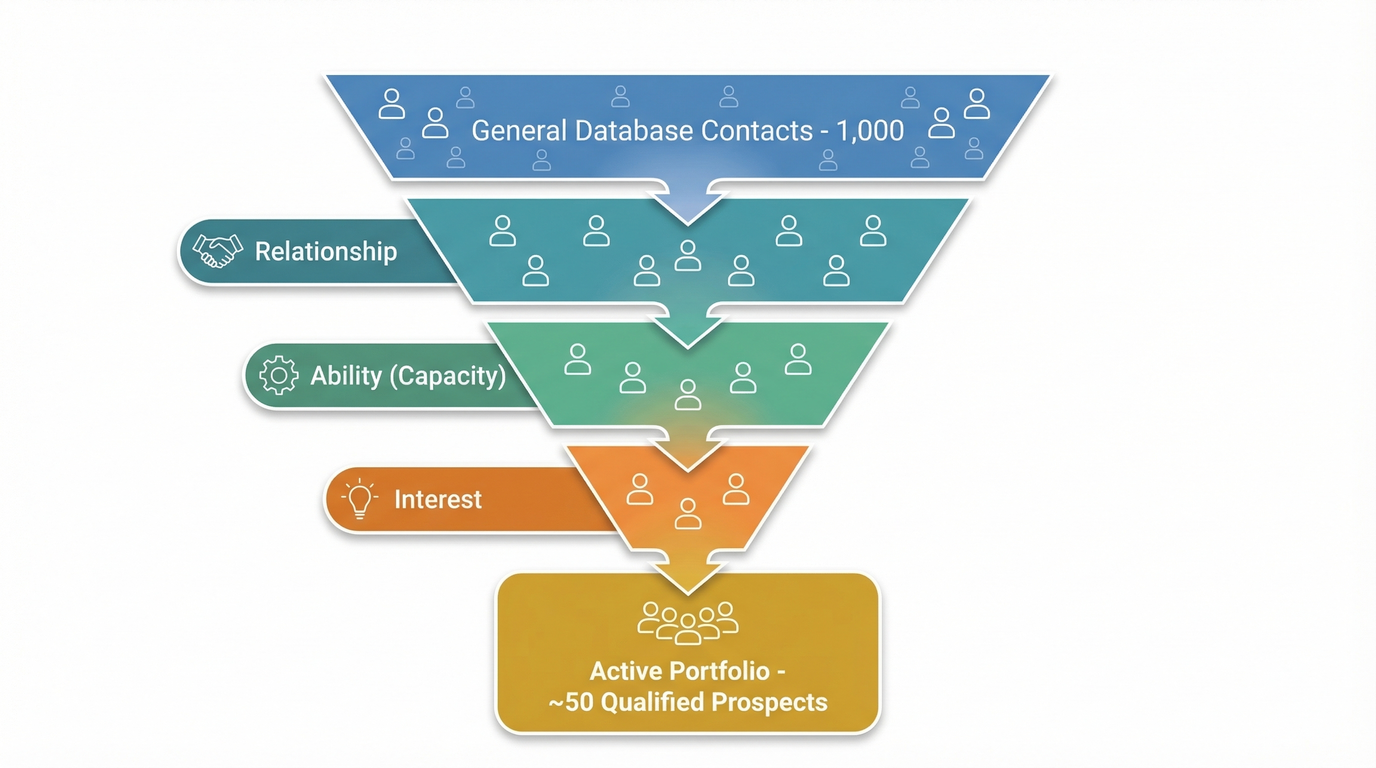
The goal of this stage is to find the right donors to focus on and determine who belongs in your major-gift portfolio. To do that, look for these three core signals:
- Proven Loyalty: They may be small, but if they are consistent and have been supporting you for, a long time, lets say 5+ yeas, this signal they are long-term committed
- Giving Capacity: Assets and previous philanthropic history provide a window into a donor’s giving potential, helping you focus your efforts where they can make the biggest impact.
- Existing Ties: Prioritize those who are already within your circle. A direct connection to your staff or board provides the trust necessary to move a relationship forward effectively.
How to identify potential high-paying donors
To find those capable of making a significant impact, we suggest you first look within your community. Your most passionate future partners are likely already walking alongside you. Keep an eye out for those who demonstrate their commitment consistently—whether they are monthly givers, long-term event guests, dedicated volunteers, or supporters who have provided steady, reliable gifts for years
Use Wealth Screening to Uncover Giving Potential
We also advise you to use wealth screening tools to estimate a donor’s financial capacity. That said, it’s also important to remember that data alone doesn’t tell the whole story. While these tools help you understand someone’s ability to give, high capacity is only one piece of the puzzle. A donor’s passion for your mission and their existing connection to your team are just as vital for truly qualifying a prospect.
Qualifying Questions to Ask:
- Do they know a board member?
- Have they attended an event in the last 2 years?
- Did they volunteer their time?
- Have they given consistently, even if modestly?
2. Qualify — Determine Who Belongs in Your Circle
After identifying those who align with your mission, you must transition from research to relationship. This means uncovering who is genuinely ready for intentional outreach—a stage we call Qualification.
During the Qualification phase you should reach out to your potential high-paying donors via… and arrange a meeting. It’s important to remember that a prospect with high wealth screening scores is not automatically a major gift candidate. That is why, the goal here isn’t to ask for money, but to learn:
- What they care about most
- Why they first gave to your organization
- What problems they want to help solve
- Whether they’re open to a deeper relationship
For example, you can use something along the lines of this opener: “We’re expanding our youth program and would love your perspective on our direction—would you have 20 minutes for a quick call?”
The 2-Attempt Rule
Don’t let unresponsive contacts stall your fundraising momentum. If a prospect doesn’t engage after two attempts, return them to your general communications track. This allows you to prioritize high-inclination prospects who are actually ready to move forward,
3. Cultivate — Build Trust and Commitment
The idea behind the Cultivation step is to transform a donor from acquaintance to partner. This is the phase where you build the relationship. And just like with relationships in real life, this takes the most time: typically 12–18 months for major gifts. Therefore, it requires patience, consistency, and personalization.
Strategic Outreach Plan
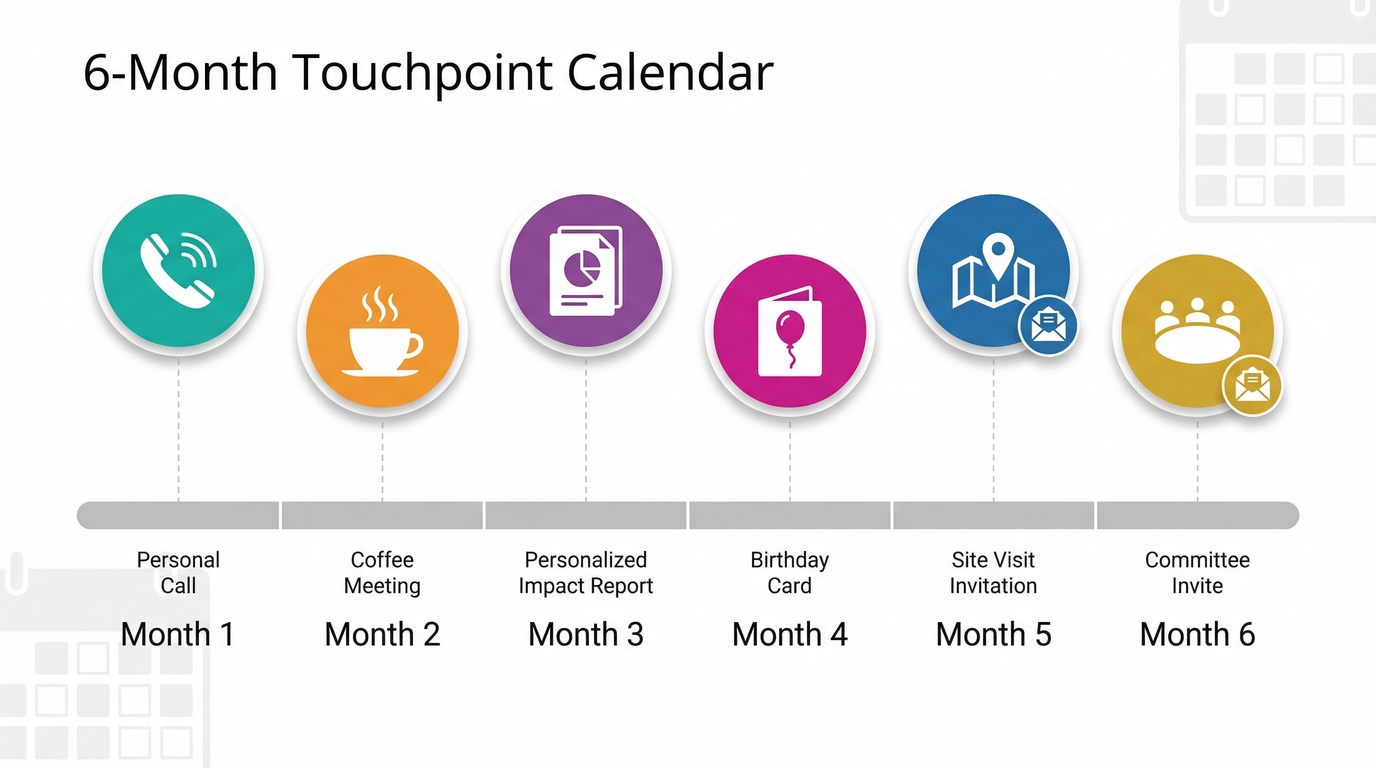
To maintain momentum without overwhelming the prospect, aim for 8–12 high-value interactions per year. These engagements should be a mix of personal and informational, such as
- Handwritten personal notes
- One-on-one coffee or lunch meetings
- Personalized program impact updates
- Invitations to small, exclusive events
- Sharing articles relevant to their specific interests
- Birthday or milestone acknowledgments
The Advocacy Move
One of the most effective cultivation strategies is inviting a donor to invest their social capital or expertise before asking for financial commitment. This “Advocacy Move” creates a sense of ownership. Consider asking them to
- Join an advisory committee
- Volunteer in a program they care about
- Speak at an event or share their story
When donors invest time and expertise, financial investment follows naturally.
4. Solicit — Make the Ask with Confidence
After a thorough cultivation phase, the solicitation stage should feel like the next logical step in your partnership. Because you’ve already invested time in building trust and shared purpose, the “ask” doesn’t come as a surprise; it serves as an invitation to take the relationship to the next level. It feels like a natural evolution, not a sales pitch.
The Gift Proposal Prepare a concise, personalized “Gift Opportunity“ document (maximum one page) that clearly answers three critical questions:
- Why this donor? Connect the request back to their specific values and past engagement.
- Why now? Define the urgent need or the specific opportunity for growth.
- What is the impact? Clearly state what a specific dollar amount ($X) will achieve for the mission.
The Two-Person Rule
For major gift solicitations, bringing two representatives to the meeting is a proven best practice:
- The Executive Director (or Senior Leader): To provide the high-level vision and ensure organizational accountability.
- A Board Member or Program Lead who shares their passion: This person serves as a familiar face, offering a peer-level perspective that turns a formal request into a shared commitment.
This combination signals that the donor’s potential gift is an organizational priority and builds a high level of credibility.
The Power of the Pause
After you make the ask, the most important thing you can do is stay silent. It is natural for a period of silence to follow a significant request. Resist the urge to fill that space with more talking. Let the donor sit with the invitation and provide them the room to respond in their own time.
5. Stewardship — Turn Donors into Lifelong Mission Partners
After all the hard work that it took to get the donor’s “yes” to donate a substantial sum to your mission, it’s only natural for you to keep that person as a lifelong mission partner rather than a one-time deal. Precisely this makes the Stewardship phase as important as the other four phases, even though some non-profits make the mistake and treat this step as less important.
The 48-Hour Thank You
Once the donor makes the donation, be sure to personally reach out via a phone call within 48 hours of the gift to show appreciation. This call may cost you five minutes of your time, but it will earn the donor’s loyalty for years and likely lead to a second gift.
Impact Reporting
Six months after the gift, send a personalized impact report that includes:
- Exactly what their gift accomplished
- Photos and stories from the programs they funded
- Specific outcomes, numbers, and results
- A clear connection between their generosity and the mission
Ongoing Engagement
Stewardship never truly ends. Keep your major donors involved in the mission with the same level of care you used during cultivation. By the time you make your next request, the partnership is already so well-established that the ask feels like a shared decision.
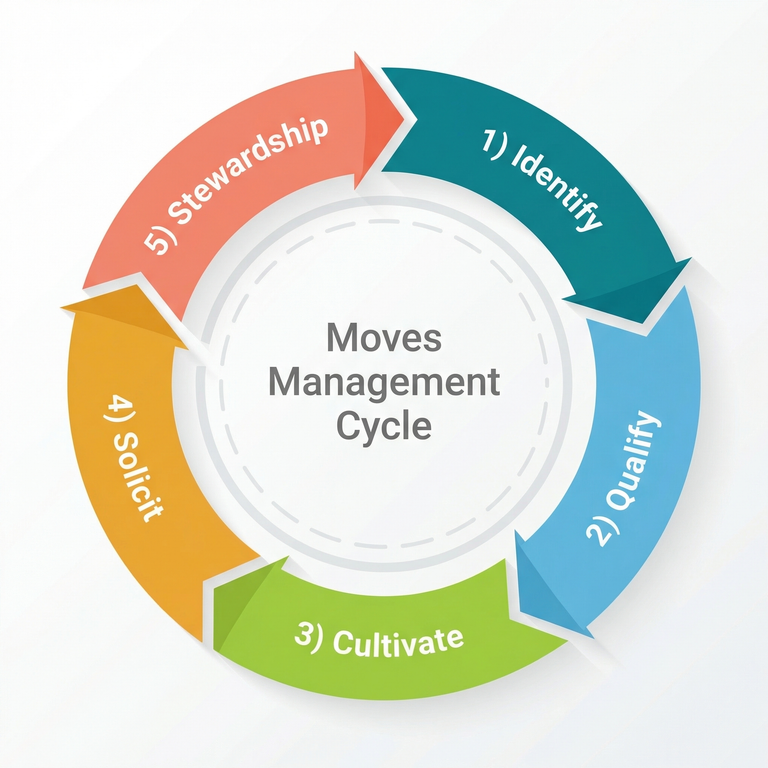
The Moves Management Cycle Visually Explained
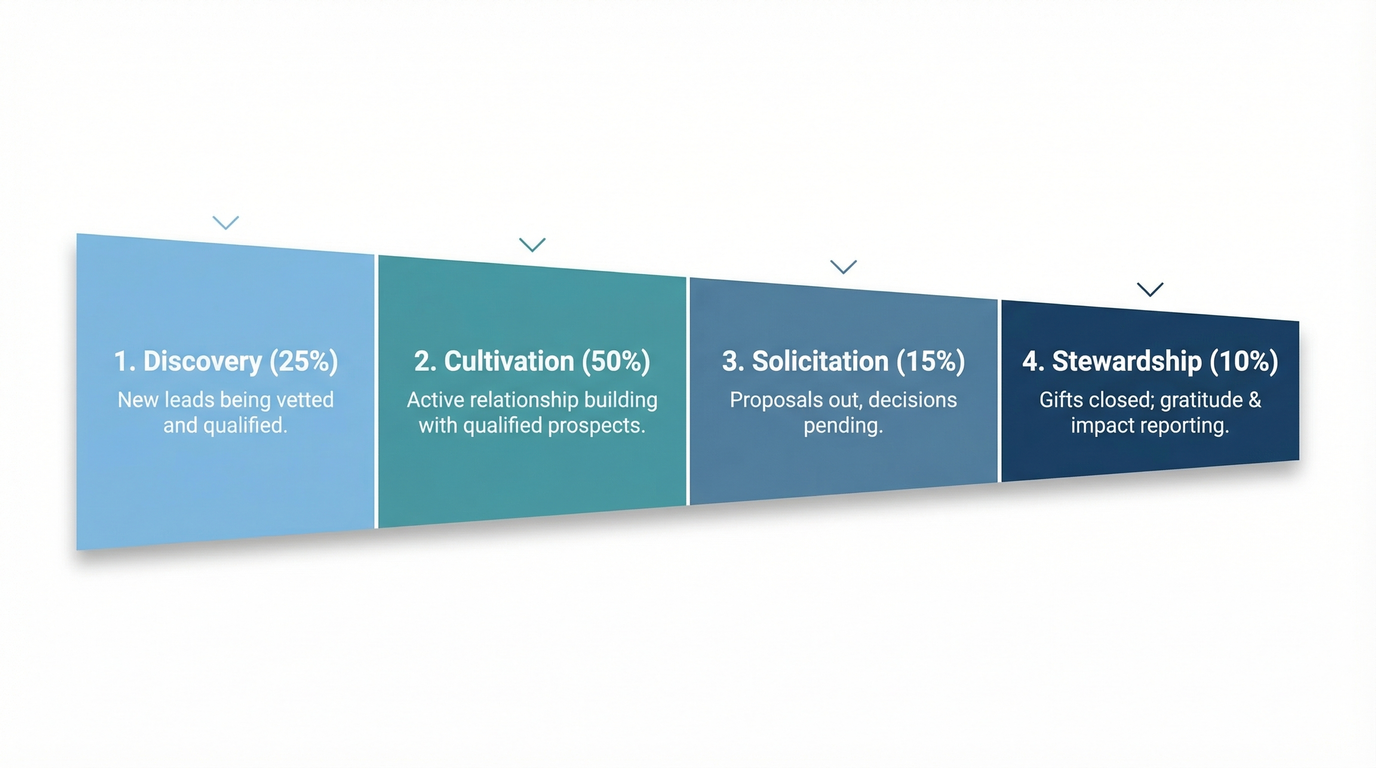
To see how these five steps function as a single ecosystem we can map them onto a continuous cycle. This chart below provides a snapshot of where your focus and your prospects should be at any given moment.
Ideally, your Moves Management system should be distributed like this
- Discovery (25%) — New leads being vetted and qualified
- Cultivation (50%) — Active relationship building with qualified prospects
- Solicitation (15%) — Proposals out, decisions pending
- Stewardship (10%) — Gifts closed, gratitude phase and impact reporting underway
Diagnosing the Stall
If your own Moves Management cycle doesn’t look like the one in the diagram, we advise you to look at which step is draining your resources. For instance, a stagnant pipeline—where 80% of your prospects are sitting in Cultivation with almost no one moving to solicitation—is a sign to review your engagement strategy and ensure donors are actually progressing to the next phase.
Common Moves Management Mistakes (and How to Avoid Them)
Over-Cultivation: Stuck in the Coffee Stage
If you’ve had six meetings and still haven’t made an ask, you’re not building a relationship—you’re stalling. Over-cultivation often stems from fear of rejection. Set a timeline for each cultivation plan and honor it.
Under-Stewardship: The Silent Treatment After the Gift
If a donor has to ask “What happened to my gift?”—you’ve already damaged the relationship. The impact report and thank-you call are not optional. They are the foundation of renewal.
Data Silos: Information That Lives in Your Head
If your donor notes live in a personal notebook or email inbox rather than your CRM, your organization is one staff departure away from losing years of relationship history. Document every move in a shared system.
No Plan Per Donor
Moves management requires an individualized plan for each prospect. Mass communication is not a move. Every donor in your active portfolio should have a written plan with clear next steps and a timeline.
Moves Management for Small Teams
Many small nonprofits believe that Moves Management is a luxury reserved for large organizations with massive departments. In reality, it is most effective for small teams because it forces you to focus your limited time on the partnerships that offer the highest return on mission.
- Prioritize a “Top 20” Portfolio: If you are a one-person development shop, don’t try to “manage” 200 prospects at once. Select 20 high-capacity, mission-aligned donors and apply the Moves Management stages rigorously to them.
- Leverage Your Board for Introductions: Small teams often have closer access to board members. Use them during the Discovery and Solicitation stages to provide the social proof and credibility that larger organizations achieve through staff volume.
- Automate the Routine: Use your CRM to automate reminders for stewardship and check-ins. This frees you up to spend your high-value time on face-to-face cultivation.
- Focus on Quality over Quantity: One well-executed “move”—like a personalized impact tour—is worth more than a dozen generic updates.
Why You Need Moves Management Software
You cannot scale a Moves Management system with spreadsheets. As your portfolio grows from 10 donors to 50 or 100+, tracking the progress of every individual partnership manually becomes impossible. By using a CRM built specifically to track the stages of a “move,” the time you would normally waste on manual spreadsheet updates is virtually eliminated—allowing you to refocus that energy on actual donor engagement.
Without dedicated software, teams regularly face:
- Missed Opportunities: Lacking automated reminders means high-value follow-ups often slip through the cracks.
- Duplicate Outreach: Without a “single source of truth,” multiple staff members may inadvertently contact the same donor, creating a confused experience.
- Vanishing History: If your donor notes live in a personal notebook or email inbox rather than your CRM, your organization risks losing years of relationship history. Whether a staff member leaves for a new role or simply misplaces their notebook, that institutional knowledge vanishes with them.
- Blind Strategy: Without a dashboard, leadership and board members have no visibility into the health of the strategy or where prospects are stalling.
How Donor Wrangler Optimizes Your Moves Management Workflow
Donor Wrangler’s Major Moves feature was built to help solve the pain points above. It was designed for nonprofits that want enterprise-level relationship management without enterprise-level complexity or cost. Here’s how it supports each stage of the moves management process:
Integrated Capacity Ratings
Rate each donor’s capacity, inclination, and relationship directly within their profile. This helps your team prioritize the top prospects in your portfolio quickly and consistently.
Status Tracking
Status indicators show exactly where each donor sits in the pipeline — from Identify through to Steward. Your entire team, including board members, can see portfolio health and donor progress at a glance.
Integrated Task Management
Never lose a follow-up again. Donor Wrangler allows you to schedule tasks with a target date for each donor, so no relationship falls through the cracks. Simply log the next step and the date you want to be reminded. Task templates simplify the process making it easier for you to replicate a workflow over and over again with fewer clicks.
Track Donor Connections
Manually record known relationships between donors and your organization’s key stakeholders. If your team knows a major prospect is connected to a board member, that link can be logged directly in the donor’s profile — so the right person can make the introduction when the time comes.
Frequently Asked Questions: Moves Management
What is an example of a “move” in fundraising?
A personalized phone call that references a donor’s specific interest area, a handwritten note sent after a site visit, or a tailored invitation to a small program event—any intentional, one-to-one action that deepens the relationship and advances the donor toward a major gift.
How long does the moves management process take?
Major gift cultivation typically takes 12–18 months from qualification to solicitation, depending on donor readiness and relationship depth. Some donors may move faster if they already have a strong relationship and inclination.
What is the difference between cultivation and stewardship?
Cultivation happens before the gift to build trust, alignment, and readiness. Stewardship happens after the gift to reinforce impact, express gratitude, and lay the foundation for the donor’s next gift.
Do small nonprofits need moves management?
Yes—moves management is especially important for small teams because it creates focus and structure where resources are limited. Instead of spreading effort thin across hundreds of donors, a small team can concentrate on a focused portfolio of 25–50 prospects and drive significant major gift revenue.
What is the Moves Management cycle?
The moves management cycle is the continuous loop of Identify → Qualify → Cultivate → Solicit → Steward, after which a retained donor re-enters the cycle for renewed or upgraded giving. Each stage flows into the next, creating a repeatable system for major gift fundraising.
What software is best for moves management?
Tools like Donor Wrangler offer built-in major moves tracking, capacity ratings, automated reminders, and relationship mapping designed specifically for the moves management process—without the complexity or cost of enterprise CRM platforms.